Wet-Ink: Sliding-Window Frontier Decoding for Diffusion Language Models
Published on Nov 7, 2026Submitted by AsilbekovControlled negative result
Abstract
Diffusion language models (dLLMs) generate tokens with parallel denoising passes over blocks of masks, and every published block decoder commits a whole block before moving on: once a block closes, its tokens are frozen. We study wet-ink decoding, an inference-time schedule in which a diffusion frontier opens tokens strictly left-to-right, exactly one per denoising step, while a sliding window of W tokens behind the frontier remains revisable through the base model's own trained token-to-token (T2T) editing gate; at distance W the ink dries and a token is never touched again. The method is implemented on LLaDA2.2-mini (16B MoE, 1.4B active) under a strict zero-invention policy: every mechanism — the greedy frontier commit, the trained gate, SPLIT/DELETE edit operations, the anti-loop resampler, and block-diagonal attention — is reused verbatim from the base model, and the decoding schedule is the only new variable, which block-diffusion theory identifies as a legitimate free inference-time choice. On GSM8K under a paired exact protocol (identical model, 4-bit quantization, prompts, and task indices), wet-ink decoding matches the stock parallel decoder on every arm: 11/45 versus 11/45 against the stock baseline (McNemar p = 1.0) and zero outcome flips against a frontier-only control across 22 common tasks, although the editing gate fires 6.9 times per task. The apparent +10.8-point accuracy gap over the internal control is a task-composition artifact, which we expose with a segment analysis. The cost is structural: ×4.88 network-function evaluations. We report this as a controlled negative result, the third consecutive one in our five-version program, and discuss what it implies for inference-time token revision in diffusion language models.
1Introduction
Autoregressive language models commit each token exactly once, in a fixed left-to-right order. Diffusion language models (dLLMs) relax both constraints: they denoise all positions of a block in parallel and may rewrite any still-masked position at any step. The relaxation buys parallelism and controllability but discards a property that writers of prose take for granted: the ability to commit early text while keeping a bounded amount of recent text correctable. A human writer does not re-plan the first sentence of every paragraph; nor do they freeze each word the instant it is written. The leading edge of the text is wet; old ink dries.
We call the decoding schedule that formalizes this intuition wet-ink decoding (Figure 1). A one-token frontier opens the leftmost remaining mask at every denoising step, committing it autoregressively; a wet window of W positions behind the frontier stays revisable; at distance W there is a hard dry edge beyond which tokens are frozen forever. The frontier is the one-token-per-step end of the published autoregression–diffusion interpolation spectrum; the wet window is realized not by a new confidence heuristic but by the base model's own trained T2T editing gate from LLaDA2.2's Levenshtein editing machinery, windowed in time.
Two design commitments distinguish this work from prior attempts at token revision in dLLMs. First, a zero-invention policy: no new formulas and no modifications of published ones; every primitive is taken verbatim from the base model's code, with line-level provenance, and the only new object is the schedule that orders the application of these primitives. Second, an adversarial evaluation protocol: paired task indices, exact McNemar tests, Wilson intervals, and NFE accounting on every arm, so that neither task sampling nor compute asymmetries can masquerade as an effect.
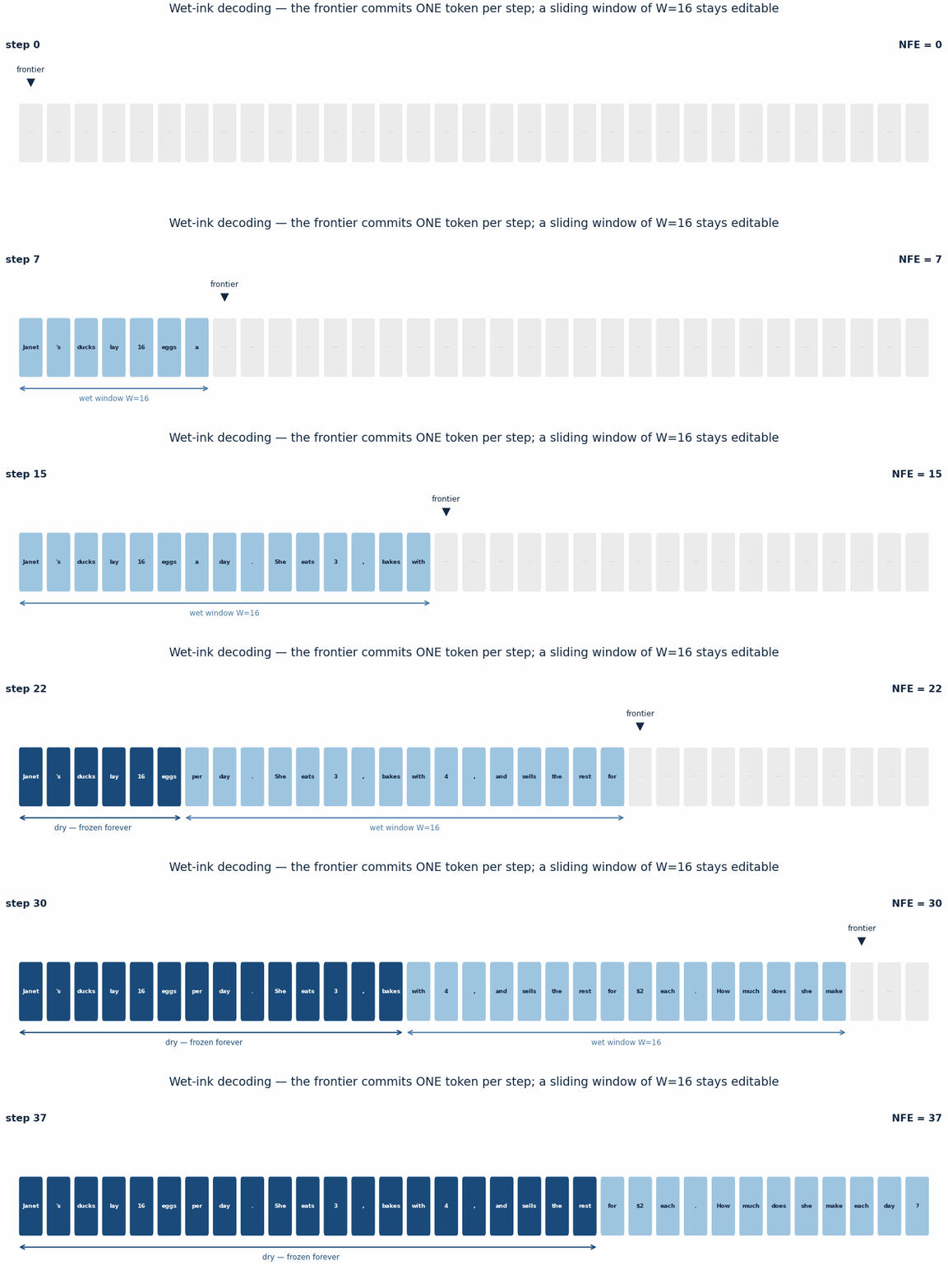
Wet-ink decoding. Each denoising step commits exactly one token at the frontier (left-to-right). A sliding window of W positions behind the frontier stays revisable through the model's trained T2T gate; positions farther from the frontier are dry and are never touched again.
The empirical outcome is unambiguous and, we argue, worth publishing as such. On GSM8K with LLaDA2.2-mini, wet-ink decoding is pair-identical to the stock parallel decoder: against the stock baseline the score is 11/45 versus 11/45 (2 outcomes fixed, 2 broken, exact McNemar p = 1.0); against a frontier-only control that disables window editing, not a single one of 22 common tasks flips, although the trained gate genuinely fires 6.9 times per task. The price is structural: ×4.88 network-function evaluations. A visible +10.8-point raw gap over the internal control turns out to be a task-composition artifact, which we demonstrate explicitly in Section 5.
This paper is the fifth iteration of a research program that treats the wet-ink idea as a hypothesis to be attacked rather than demonstrated. Our contributions:
- A wet-ink decoder for LLaDA2.2-mini: a one-token left-to-right frontier with a sliding window of W revisable tokens, a hard dry edge, built exclusively from the base model's own trained mechanisms under a zero-invention policy with full provenance.
- A paired evaluation protocol for decoding schedules: exact McNemar tests on common task indices, Wilson intervals, NFE accounting, and task-composition controls.
- A controlled negative result: the trained editing gate, given a sliding window and an honest budget, does not move task accuracy on GSM8K — with a segment-level analysis showing why raw gaps in small-n benchmark runs can be pure composition artifacts.
2Background and Related Work
Masked diffusion LMs and block decoding
Masked dLLMs such as LLaDA and Dream 7B generate by iteratively denoising a span of [MASK] tokens. The standard inference implementation is block decoding: the response of length L is split into blocks of B tokens (typically B=32); within a block, each denoising step predicts all positions at once, a transfer schedule allocates how many tokens each step may commit, a confidence threshold governs which candidates are accepted, and once the block's masks are resolved the block is frozen forever. LLaDA2.2-mini augments this pipeline with Levenshtein editing: trained DELETE and SPLIT operations, an anti-loop resampler, and a token-to-token (T2T) editing gate that may replace a previously opened token with a new prediction when the model is confident and the prediction differs. The editing window of the stock implementation is the current block only: when a block closes, its ink dries at once, and no later block can repair it. Our starting question was whether a window that slides behind a moving frontier — wet ink that dries gradually rather than blockwise — changes anything.
The autoregression–diffusion interpolation spectrum
That the ordering and granularity of token commits are free inference-time variables, not model properties, is the central insight of the block-diffusion line of work. BD3-LM trains block-AR discrete diffusion models in which block sizes trade parallelism against conditioning; Set Diffusion goes further and interpolates token orderings between fully parallel (diffusion) and fully left-to-right (autoregressive) decoding at inference time, reporting favorable speed–quality trade-offs. Our frontier — one token per step, strictly left-to-right — is exactly the autoregressive end of this spectrum, composed with the stock denoising machinery of a fixed trained model. Related efficiency work optimizes the sampling schedule, decodes adaptively in parallel, or caches attention across steps; all are orthogonal to token revisability, which is our subject.
Token revision and remasking
Revising opened tokens is a recognized open problem. RemeDi trains a remask-aware model whose per-token confidence decides which open tokens to re-mask each step. A family of training-free rules adapts the same idea to fixed models: WINO, Saber, and COVER re-mask low-confidence open tokens under various budgets; CoDR masks a partition of the window, measures the confidence drift of the remaining tokens, and re-masks on drift. The recent calibration study of Frković et al. is the most direct precedent for our skepticism: under greedy decoding and short blocks, all three training-free remasking rules they test perform on par with confidence-based unmasking alone, and their analyses locate the bottleneck in the dLLM itself. Our program engaged this literature sequentially before building the v5 decoder reported here: v2–v3 ported RemeDi's and CoDR's published cycles verbatim to Nemotron-Labs-Diffusion-3B and found them neutral (CoDR) to significantly harmful (RemeDi, −19.5 to −31.5 points on GSM8K/HumanEval, p < 0.001); v4 audited the stock editing parameters of LLaDA2.2-mini; v5 finally gave the trained editing gate the sliding window it never had.
3The Wet-Ink Decoder
Stock block decoding of LLaDA2.2-mini
Let x ∈ VB be the current block of B positions, some of them open (decoded) and some [MASK]ed. One stock denoising step computes, for every position i, a categorical p(· | x) over the vocabulary, the greedy prediction x0(i) = argmaxv p(v | x), and its confidence p0(i) = p(x0(i) | x). A per-step token budget nt determines how many masks may open: candidates are ranked by confidence, and a mask opens if it is within the budget and its confidence exceeds the threshold τ. After all masks of the block are resolved, a post-phase of up to S further steps may edit open tokens of the same block through the trained T2T gate
edit(i) = 𝟙[ p0(i) > τe ∧ xi ≠ x0(i) ](1)combined with trained SPLIT/DELETE operations, an anti-loop resampler, and residual special-token suppression; then the block freezes forever. Editing is thus confined to the current block: there is no mechanism, in any configuration of the stock parameters, for a later block to repair an earlier one.
The wet-ink schedule
Wet-ink decoding keeps every one of these primitives and changes only the schedule: which position opens, and which positions stay revisable, at each step.
Frontier. Within the current block, define the frontier f as the number of leading positions already committed. Each denoising step opens exactly one token — the leftmost remaining mask — and commits it greedily (T=0, deterministic):
xf ← x0(f), f ← f + 1(2)Progress is guaranteed by construction: each step removes exactly one mask, so the block resolves in exactly B steps — no step limit is ever reached, and the churn explosions of our v1 cannot occur. This is the one-token-per-step, left-to-right end of the ordering spectrum of Set Diffusion.
Wet window and hard dry edge. Behind the frontier, the W most recent positions stay revisable through the stock gate of Eq. (1). Formally, we override the model's editing confidence field with a windowed version,
p̃0(i) = p0(i) if f − W ≤ i < f (wet); −∞ otherwise (dry)(3)and run the unmodified gate 𝟙[p̃0(i) > τe ∧ xi ≠ x0(i)]. The window is clipped to the current block, matching the model's block-diagonal attention. Positions that leave the window are frozen forever — the ink dries with distance from the frontier, which is the entire content of the wet-ink idea.
Post-phase. Once all masks of the block are resolved, up to S=4 further steps keep the last W positions wet (the drying tail), reusing the stock post-phase machinery with a smaller budget; then the block freezes with stock semantics. Blocks attend to previous blocks exactly as in stock decoding, and the KV cache of frozen blocks is reused verbatim.
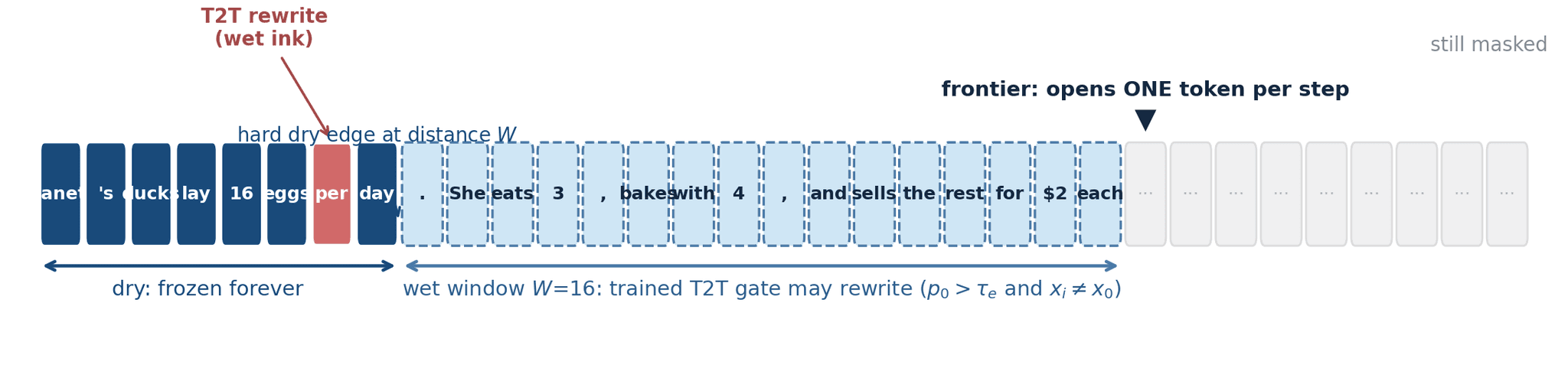
Figure 1. A snapshot of one step: frozen prefix (dry ink), wet window [f−W, f) revisable through the trained T2T gate, the frontier committing one token, and the still-masked remainder.
Input:  prompt context, block length B, window W ≤ B,
        edit threshold τe, post steps S
f ← 0                                    ▷ frontier: committed prefix length
while f < B do
    forward pass (stock block-diagonal attention)
    commit x[f] ← x0(f) greedily;  f ← f + 1     ▷ one token per step
    for i in [max(f−W, 0), f) do                  ▷ wet window
        if p0(i) > τe and x[i] ≠ x0(i) then
            x[i] ← x0(i)                          ▷ rewrite while wet
    apply trained SPLIT/DELETE ops and anti-loop resampler (stock code)
for s = 1 .. S do
    drying-tail steps: last W positions remain wet (stock post-phase)
return block tokens                          ▷ block freezes; next block starts
Zero-invention policy and provenance
The method was built under a self-imposed rule: no new formulas and no modifications of published ones. Table 1 lists every component and its verbatim source in the base model. The only new object is the schedule of Eqs. (2)–(3) — which positions open and which stay wet per step — which the block-diffusion literature identifies as a free inference-time variable rather than a model change. Two safeguards verify this at runtime: with W=0 the decoder is bit-identical to an appropriately configured stock decode (verified on the full model, ids_equal=True), and a residual-token detector asserts zero leaked special tokens in every generation.
| Component | Verbatim source (LLaDA2.2-mini) |
|---|---|
| Greedy commit x0, confidence p0 | stock generate() sampling step |
| T2T editing gate, Eq. (1) | _joint_decode_block (L-EBPO trained) |
| SPLIT / DELETE edit ops | _apply_edit_operations_with_tracking |
| Anti-loop resampler | _resample_to_escape_loop |
| Block-diagonal attention, KV-crop | stock generate() / cache utilities |
| Frontier + wet window (new) | this work — schedule only |
4Experimental Setup
Model and hardware. All experiments use inclusionAI/LLaDA2.2-mini (16B-parameter MoE, 1.4B active, Apache-2.0) loaded with trust_remote_code=True, quantized to 4-bit NF4 (bitsandbytes, double-quantization, fp16 compute) with eager attention — SDPA rejects the bf16 editing mask; eager promotes it to fp32, which is the model's own attention path. The kernel ran on Kaggle with two Tesla T4 GPUs, one full copy of the model per GPU and two independent workers behind a priority queue with an adaptive per-benchmark scheduler (plan_n). Stack: torch 2.11.0+cu130, transformers 5.2.0, CUDA 13.0.
Protocol. We evaluate on the first 45 GSM8K test tasks (fixed indices), 4-shot prompting as in the base model's documentation, greedy decoding (T=0), gen_length=160, block_length=32, max_post_steps=4, and report exact-match accuracy on the final numeric answer. Arms: wetink_w16 (the method, W=16), wetink_noedit_w16 (frontier-only control: W positions stay visible but the editing gate is disabled), and wetink_w8 (narrow window). Every generation records token-level telemetry: forward passes (NFE), opened tokens, actual rewrites, churn, and residual special tokens.
Paired baselines. The stock baselines (stock_b32: the model's own generate() with stock thresholds; noedit_b32: same with editing disabled) come from a completed earlier run of ours on the same model, the same quantization, the same prompts, the same generation length, and the same task indices, which makes every comparison paired by task index. We report exact McNemar tests on the paired outcomes, Wilson 95% confidence intervals for each arm, and NFE ratios computed on the common task subset. No baseline number in this paper comes from an unpaired or differently-configured run.
Budget honesty. The kernel ran for 6 h 04 m of a 7.5 h budget and produced 77 generations across three arms (n = 45, 22, 10). Two planned arms — the W=32 window and HumanEval — were skipped by the scheduler because the budget was exhausted (logged as skipped: time budget); we report this rather than silently omitting the arms. The frontier-only control stopped after the first 22 tasks for the same reason, a fact that matters for the analysis of Section 5. A truncation confound applies to all arms equally: at gen_length=160, most generations are cut before the model finishes; in the v4 audit, among the naturally EOS-terminated generations 96% were answered correctly, so absolute accuracies here underestimate the model.
5Results
Main comparison
Table 2 reports the primary numbers. The wet-ink arm reaches 24.4% (11/45) against the stock baseline's 22.5% (18/80) — a raw difference of +1.9 points with Wilson intervals that overlap almost entirely. The frontier-only control scores 13.6% (3/22), which would suggest a dramatic +10.8-point editing effect; the paired analysis shows this appearance is false.
| Arm | n | Accuracy | Wilson 95% CI | NFE | Rewrites/task |
|---|---|---|---|---|---|
| wetink_w16 (ours, W=16) | 45 | 24.4% | [14.2, 38.7] | 206.6 | 6.9 |
| wetink_noedit_w16 (frontier only) | 22 | 13.6% | [4.7, 33.3] | 201.1 | 0 |
| wetink_w8 (narrow window) | 10 | 20.0% | [5.7, 51.0] | 202.7 | 5.6 |
| stock_b32 (v4 baseline) | 80 | 22.5% | [14.7, 32.8] | 42.5 | — |
| noedit_b32 (v4 baseline) | 80 | 23.8% | [15.8, 34.1] | 50.1 | — |
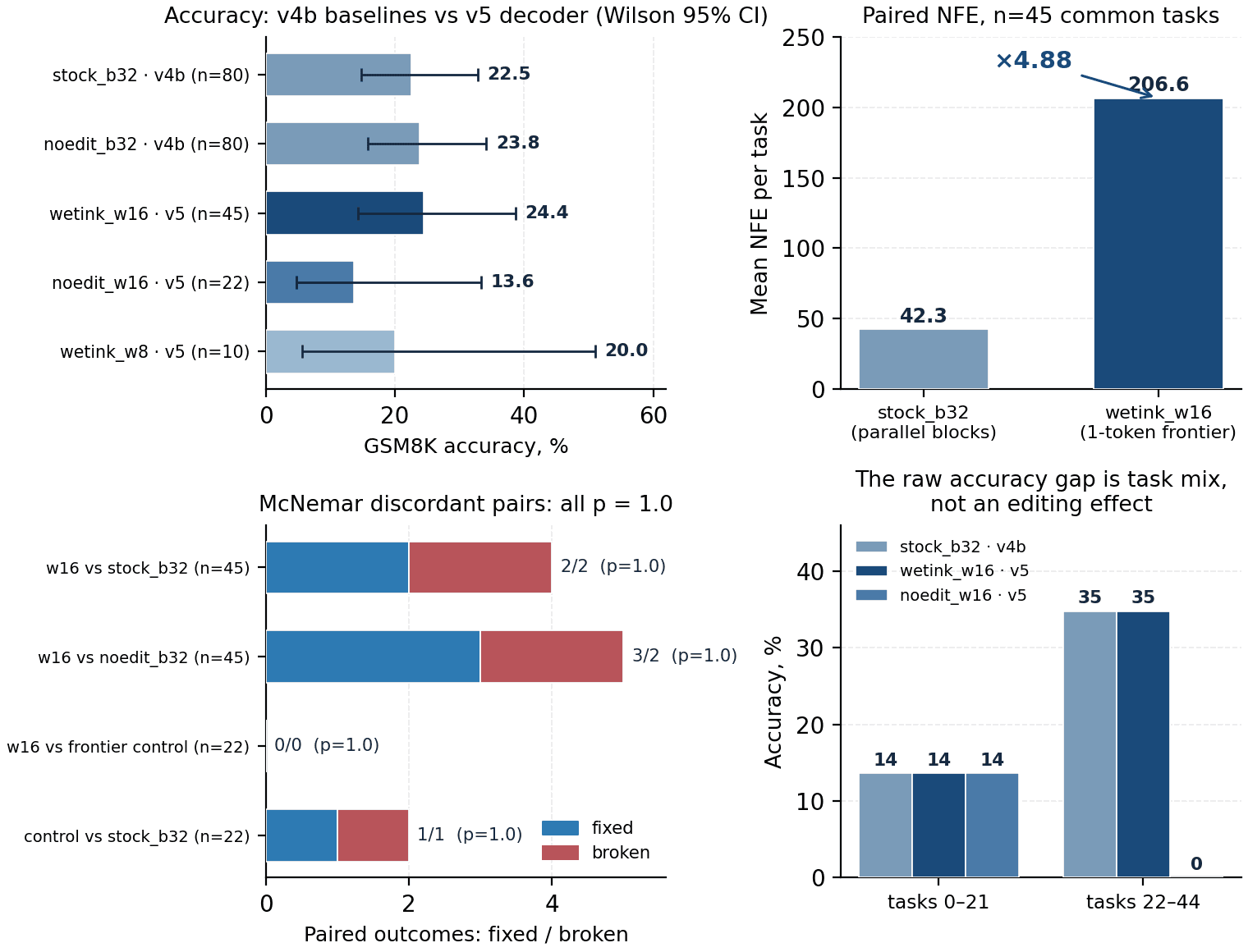
Results. (a) Accuracy with Wilson 95% intervals for all arms. (b) Paired NFE on common tasks: stock versus wet-ink (×4.88). (c) McNemar discordant pairs for four comparisons — all p = 1.0. (d) Segment analysis: on the hard tasks 0–21 every arm scores 13.6%; the raw accuracy gap between arms reflects which segments they cover, not an editing effect.
Paired exact analysis
Table 3 gives the paired outcomes. Against the stock baseline, the wet-ink arm solves exactly the same number of the 45 common tasks (11 versus 11), with 2 outcomes fixed and 2 broken (exact McNemar p = 1.0). Against the frontier-only control on the 22 common tasks, the window edits flip zero outcomes (3/22 versus 3/22, 0 fixed, 0 broken). The control itself matches the stock baseline (3/22 versus 3/22, p = 1.0). In other words: the one-token frontier costs nothing in accuracy relative to stock decoding, and the editing window adds nothing on top of the frontier.
| Comparison (common n) | Score A | Score B | Fixed | Broken | p |
|---|---|---|---|---|---|
| wetink_w16 vs stock_b32 (45) | 11/45 | 11/45 | 2 | 2 | 1.0 |
| wetink_w16 vs noedit_b32 (45) | 11/45 | 10/45 | 3 | 2 | 1.0 |
| wetink_w16 vs control (22) | 3/22 | 3/22 | 0 | 0 | 1.0 |
| control vs stock_b32 (22) | 3/22 | 3/22 | 1 | 1 | 1.0 |
The task-composition artifact
The +10.8-point raw gap between the wet-ink arm (24.4%) and its own frontier-only control (13.6%) deserves a careful look, because it is exactly the kind of number that is usually reported as a win. The mechanism is mundane: the control arm exhausted its time budget after the first 22 tasks, and the first 22 GSM8K indices are systematically harder for this model — under 4-bit quantization and a 160-token cap — than indices 22–44. On the hard segment (tasks 0–21) every arm scores exactly 13.6%: stock, control, and wet-ink. On the easier segment the wet-ink arm scores 34.8% and the stock baseline 25.9%. The raw gap is therefore a statement about which tasks each arm happened to cover, not about editing; the paired tests, which compare only common indices, correctly report no effect. We flag this because unpaired comparisons between unequally-truncated arms are easy to make in budget-limited GPU settings and would have produced a false positive here.
NFE accounting and mechanics
The wet-ink arms cost 206.6 NFE per task versus 42.3 for stock on the same 45 tasks — a structural ×4.88 multiplier, the price of committing one token per forward pass. This multiplier is predictable (it cannot churn: progress is one mask per step by construction), unlike our v1 experience where a training-free revision rule inflated NFE 9–13× with ~589 re-masking events per block, ~0.4 of which were real changes. In v5 the trained gate fires 6.9 real rewrites per task (churn 5.6) — the editing machinery is demonstrably active, not disabled — and yet moves no outcomes. Mechanics were verified on all 77 generations: bit-exact W=0 equivalence (ids_equal=True, NFE 97=97), zero residual special tokens, and deterministic outputs under T=0.
Five versions as an ablation narrative
Table 4 summarizes the program that led here. Read as one experiment, it is a five-step attack on the same hypothesis: can inference-time token revision improve a fixed dLLM? Training-free rules on the fixed Nemotron model were harmful (v2–v3); the trained stock gate with a fixed block window is neutral (v4); the trained gate with the sliding window it was arguably designed for is still neutral (v5). Three independent, paired, consistently null results — in line with the calibration of Frković et al. — shift the burden of proof toward approaches that change training, not decoding.
| Ver. | Decoding scheme | Outcome (paired) |
|---|---|---|
| v1 | confidence-gate re-masking each stock step | +6 pts GSM8K but ×9–13 NFE churn; termination invariant broken |
| v2 | full published revision cycles (RemeDi, CoDR) | termination restored; RemeDi harmful at short blocks, CoDR near-neutral |
| v3 | full benchmark, n=200 GSM8K + 164 HumanEval | RemeDi −12.5 to −31.5 pts (p<0.001); CoDR neutral (p=1.0) |
| v4 | stock generate() parameter audit (12 arms, 403 gens.) | stock T2T gate neutral (p=1.0), −15% NFE; window does not slide |
| v5 | wet-ink: sliding window over trained gate | paired-identical to stock (p=1.0) at ×4.88 NFE |
6Discussion
Why is the trained gate inert here? The T2T gate of LLaDA2.2 was trained, via L-EBPO, in a regime where editing happens inside the current block while parallel denoising is still resolving it — its rewrites correct early sampling noise within a block that is still being written. Our schedule relocates those rewrites to a window behind a one-token frontier, a distribution the gate was never trained on; the model's confidences behind the frontier are apparently already well calibrated — the gate fires (6.9 rewrites per task) but its rewrites are almost always confidence-neutral polish, not error repair. The result echoes the diagnosis of Frković et al.: the bottleneck is the dLLM's ability to detect its own mistakes, not the schedule through which revisions are applied. A gate trained with a sliding window — or any trained mistake detector — is the natural next experiment, and our kernel is ready to host it.
What the negative result buys. First, a clean baseline: any future claim that sliding-window revision helps a LLaDA2-class model must now beat an honestly-paired null, and our segment analysis gives reviewers a concrete failure mode — unequal arm coverage — to check for. Second, a cost bound: the revision opportunity is available at a predictable ×4.88 NFE, and a k-token frontier would divide that multiplier by k without touching a single formula; if a future trained gate does help, the engineering path to it is already cheap. Third, the zero-invention methodology itself: every component of our decoder is verbatim model code with runtime equivalence checks, which is what made the null result interpretable rather than confounded by an accidental model change.
7Limitations
Our conclusions are bounded by four constraints. (i) Sample size: the main arm has n=45 and the control n=22; Wilson intervals span ±12 points, so we can exclude large effects but not effects of a few points; detecting a ±5-point effect would require n ≥ 500 per arm. (ii) One model, one benchmark, one regime: results are for LLaDA2.2-mini at 4-bit quantization on GSM8K with greedy decoding and a 160-token cap that truncates most generations; the HumanEval arm was skipped by the time budget. (iii) Window sizes: only W=16 (main) and W=8 (ablation, n=10) ran; W=32 was not reached. (iv) Ablation identity: the frontier-only control differs from the wet-ink arm by the editing gate alone, but the wet-ink family as a whole differs from stock decoding by the schedule; we disentangle schedule cost (NFE) from editing effect (outcome flips), not the joint interaction with sampling temperature, which we fixed at zero.
8Conclusion
We implemented wet-ink decoding — a one-token left-to-right frontier with a sliding window of revisable tokens and a hard dry edge — for a modern diffusion language model, under a zero-invention policy in which every mechanism is the base model's own trained code. Under a paired exact protocol the method preserves the stock decoder's accuracy arm for arm (McNemar p = 1.0 everywhere), its apparent advantage over an internal control dissolves into a task-composition artifact, and its cost is a predictable ×4.88 NFE. Together with the four earlier versions of this program, the evidence indicates that inference-time token revision, by any rule so far published, does not improve a fixed diffusion language model in the greedy, short-block regime; revision that helps will likely have to be trained. Code, data, full telemetry, and the reproduction kernel are public at github.com/Asilbekov/Explore and huggingface.co/Freedomform/wet-ink-v5.
References
- [1]Nie, S., Zhu, F., You, Z., et al. Large language diffusion models. NeurIPS 2025. arXiv:2502.09992.
- [2]inclusionAI LLaDA2.2-mini: a lightweight agentic MoE diffusion language model with Levenshtein editing. Hugging Face model card, 2026.
- [3]Bie, T., Cao, M., Cao, B., et al. LLaDA2.1: speeding up text diffusion via token editing. arXiv:2602.08676, 2026.
- [4]Ye, J., Xie, Z., Zheng, L., et al. Dream 7B: diffusion large language models. arXiv:2508.15487, 2025.
- [5]Arriola, M., Gokaslan, A., Chiu, J. T., et al. Block diffusion: interpolating between autoregressive and diffusion language models. ICLR (Oral) 2025. arXiv:2503.09573.
- [6]Arriola, M., Gokaslan, A., Chiu, J. T., et al. Set diffusion: interpolating token orderings between autoregression and diffusion for fast and flexible decoding. ICML 2026. arXiv:2607.01775.
- [7]Gu, J., Wang, C., Zhao, J. Levenshtein transformer. NeurIPS 2019. arXiv:1905.11006.
- [8]Frković, S., Jazbec, M., Zhang, D., Naesseth, C. A., Bogunović, I., Nalisnick, E. Re-evaluating confidence remasking in masked diffusion language models. NeurIPS 2026. arXiv:2606.12232.
- [9]Huang, Z., Wang, Y., Chen, Z., Qi, G.-J. Don’t settle too early: self-reflective remasking for diffusion language models. arXiv:2509.23653, 2025.
- [10]Wu, Y., Zhang, Q., Zhang, Y., Huang, J. CoDR: training-free confidence-drift remasking for diffusion language models. arXiv:2610.08833, 2026.
- [11]Wu, C., Zhang, H., Xue, S., et al. Fast-dLLM: training-free fast diffusion large language model inference. arXiv:2505.22618, 2025.
- [12]Israel, D., Van den Broeck, G., Grover, A. Accelerating diffusion LLMs via adaptive parallel decoding. arXiv:2506.00413, 2025.
- [13]Park, Y.-H., Lai, C.-H., Hayakawa, S., Takida, Y., Mitsufuji, Y. Jump your steps: optimizing sampling schedule of discrete diffusion models. arXiv:2410.07761, 2024.
- [14]Schiff, Y., Belhasin, O., Uziel, R., et al. Learn from your mistakes: self-correcting masked diffusion models. arXiv:2602.11590, 2026.
- [15]Dong, Y., Ma, Z., Jiang, X., et al. Saber: an efficient sampling with adaptive acceleration and backtracking enhanced remasking for diffusion language models. arXiv:2510.18165, 2025.
Linked artifacts
Citation
@techreport{asilbekov2026wetink,
  title  = {Wet-Ink: Sliding-Window Frontier Decoding for Diffusion Language Models},
  author = {Asilbekov, Ozodbek},
  year   = {2026},
  url    = {https://github.com/Asilbekov/Explore},
  note   = {Technical report; paired evaluation on GSM8K with LLaDA2.2-mini}
}
Discussion
Comments are stored locally on this page's server (no account needed).